
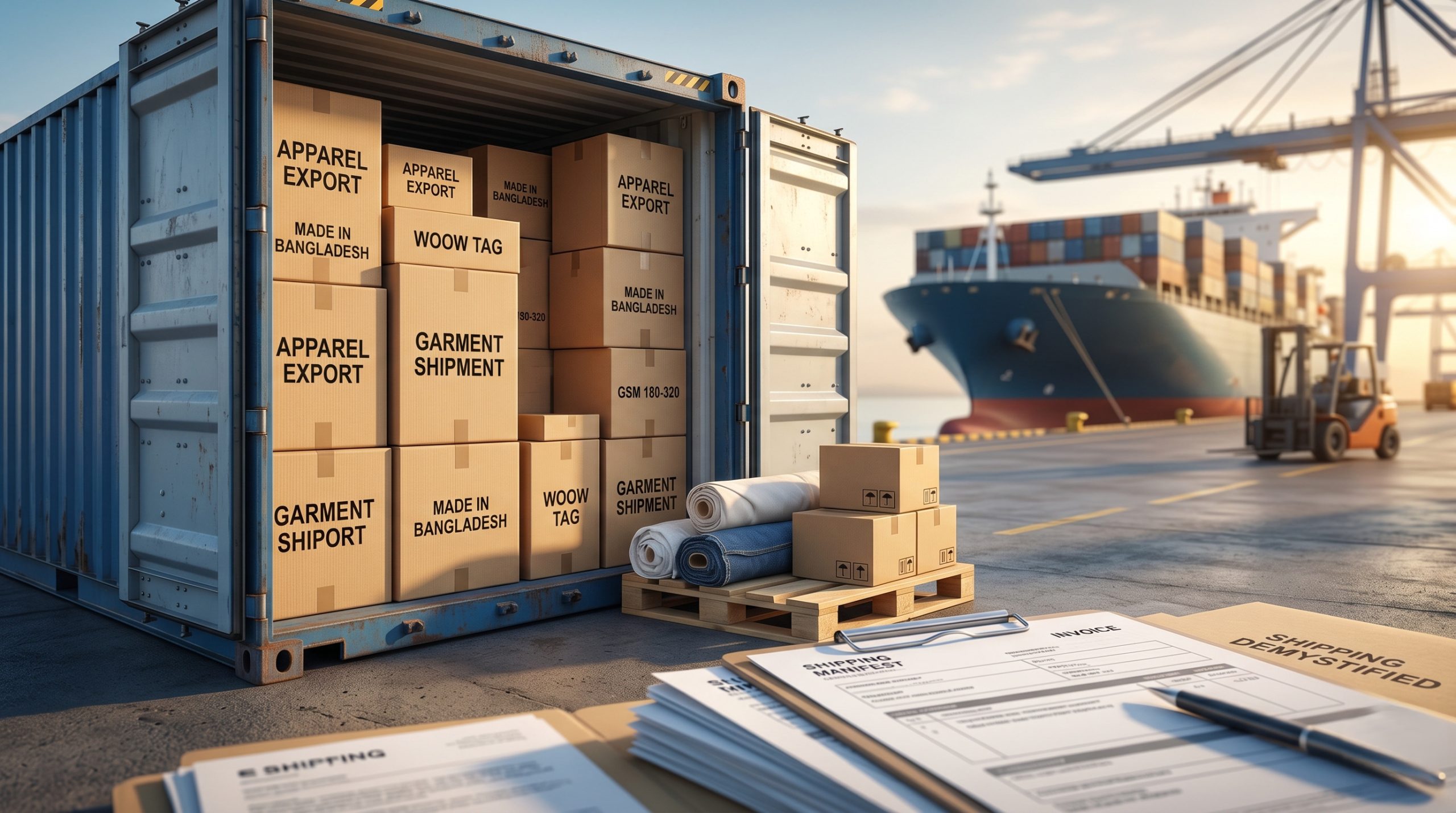

Primary Keywords: Apparel export logistics | Garment shipping dimensions | Calculating sea freight volume
Secondary Keywords: GSM fabric weight | FCL vs LCL shipping | Carton optimization | Denim export | Jersey fabric GSM | CBM calculation garments
Word Count: ~1,600 words | Read Time: ~8 minutes
Search Intent: Informational + Transactional (High-Intent Global Buyers)
Introduction: Why Logistics Is the Hidden Variable in Apparel Exports
In the global apparel trade — valued at USD 473 billion in 2023 and projected to cross USD 590 billion by 2027 (Statista, 2024) — price and quality are table stakes. What separates consistently profitable exporters from the rest is mastery over apparel export logistics.
Missed carton dimensions. Underestimated cubic weight. Wrong GSM declared on shipping documents. Each of these errors costs real money: freight overpayments, customs holds, or buyer deductions. For sourcing managers, freight forwarders, and merchandisers operating out of high-volume export hubs like Bangladesh, India, Vietnam, and Turkey, understanding the technical mechanics of packaging, GSM classification, and sea freight calculation isn’t optional — it’s a competitive differentiator.
This article breaks down the exact frameworks used by seasoned export teams to optimize their garment shipping dimensions, master GSM specifications for key fabric categories, and calculate sea freight volume with precision.
Section 1: Understanding GSM — The Fabric Weight Standard That Drives Freight Cost
GSM (Grams per Square Meter) is the universal unit used to define fabric weight in international apparel trade. It directly influences shipment weight, carton planning, and in some cases, HS code classification — all of which affect your landed cost.
GSM Reference Chart for Key Fabric Categories
| Fabric Type | Typical GSM Range | Export Application | Weight per 100 Pcs (est.) |
|---|---|---|---|
| Single Jersey (T-shirt) | 140–180 GSM | Basics, activewear | 8–12 kg |
| Heavy Jersey / Fleece | 280–380 GSM | Hoodies, sweatshirts | 22–30 kg |
| Lightweight Denim | 6 oz (204 GSM) | Summer denim, shorts | 16–20 kg |
| Standard Denim | 10–12 oz (340–408 GSM) | Jeans, jackets | 28–35 kg |
| Woven Poplin (Shirt) | 90–120 GSM | Formal shirts | 6–9 kg |
| Polar Fleece | 200–300 GSM | Outerwear lining | 18–24 kg |
Practical Insight: A 20-foot FCL container carrying 10 oz denim jeans (~32 GSM kg per 100 pcs) will hit the weight limit (~21,000 kg net) before it fills volumetrically. This is a critical planning variable — ignoring it leads to either dead freight or detention charges.
GSM in Customs Documentation
For Bangladesh and India — two of the world’s top three RMG exporters — GSM is a mandatory field in:
- Certificate of Origin (CO/GSP/FORM-A)
- Export LC documentation
- EU REACH compliance declarations
Misrepresenting GSM (e.g., declaring 180 GSM for what is actually 220 GSM fleece) can trigger customs audits and duty reclassification in destination markets, particularly the EU, USA, and UK.
Section 2: Garment Packaging Standards — Carton Dimensions That Minimize Freight Waste
Carton optimization is one of the highest-ROI activities in apparel export logistics — yet it’s consistently under-optimized.
Standard Export Carton Dimensions by Category
| Garment Category | Recommended Carton (L × W × H cm) | CBM/Carton | Pcs/Carton (typical) |
|---|---|---|---|
| T-shirts (folded flat) | 60 × 40 × 40 | 0.096 CBM | 48–72 pcs |
| Denim Jeans | 60 × 40 × 45 | 0.108 CBM | 24–36 pcs |
| Hoodies / Sweatshirts | 65 × 45 × 45 | 0.131 CBM | 12–24 pcs |
| Dress Shirts (hanger-packed) | 68 × 38 × 52 | 0.134 CBM | 12 pcs |
| Children’s Wear | 50 × 35 × 35 | 0.061 CBM | 48–96 pcs |
The Carton Dimension Rule: Fit the Container, Not the Garment
A common mistake is sizing cartons around the garment fold rather than around container stacking efficiency. The goal is maximizing the number of cartons per tier and tiers per stack.
Key principle: Most 20-foot standard containers have an internal floor space of approximately 5.9m × 2.35m and an internal height of 2.39m. For a carton with H = 40 cm, that allows 5 full tiers of stacking (200 cm), leaving 39 cm of usable headroom — often wasted.
Shifting from a 40 cm high carton to a 42 cm high carton (adding 2 cm of extra packing) adds 1 additional piece per carton with zero freight cost increase.
Poly Bag and Inner Pack Standards
For retail-ready exports, buyers in the US and EU increasingly mandate:
- Individual poly bags with suffocation warnings (mandatory for US retail)
- Size sorting (S/M/L/XL) clearly labeled per inner pack
- Barcode/UPC on each poly bag matching the buyer’s GS1 standard
These add approximately 0.5–1.2 grams per unit to shipment weight — negligible per piece, but across a 50,000-unit order, that’s an additional 25–60 kg, which can push a shipment into the next freight bracket.
Section 3: Calculating Sea Freight Volume — The CBM Formula Every Exporter Must Master
Calculating sea freight volume accurately is the foundational skill in export costing. Errors here — whether overestimating or underestimating — translate directly into margin erosion.
The CBM Formula
CBM = Length (m) × Width (m) × Height (m)

For a carton of 60cm × 40cm × 40cm:
CBM = 0.60 × 0.40 × 0.40 = 0.096 CBM per carton
For an order of 500 cartons:
Total CBM = 500 × 0.096 = 48 CBM
FCL vs. LCL: The Volume Threshold Decision
| Shipment Mode | Break-even Point | Best For | Cost Indicator |
|---|---|---|---|
| LCL (Less than Container Load) | < 15 CBM | Small/sample orders | USD 35–80/CBM (port-to-port) |
| 20′ FCL | 15–25 CBM | Mid-volume orders | USD 800–2,500/container (market-dependent) |
| 40′ FCL | 50–76 CBM (max) | High-volume, routine orders | USD 1,200–3,500/container |
| 40′ HC (High Cube) | Up to 86 CBM | Bulky/lightweight garments | USD 1,300–3,800/container |
Data Point: According to Freightos Baltic Index (FBX) data (Q1 2024), Asia-to-North America FCL rates for a 40′ container averaged USD 2,100–4,600, down sharply from the 2021–2022 peak of USD 10,000–20,000+. For exporters, this normalization means LCL-to-FCL threshold decisions should be re-evaluated quarterly.
Chargeable Weight vs. Actual Weight
For air freight (used for urgent replenishments or sample shipments), the volumetric weight formula applies:
Volumetric Weight (kg) = (L cm × W cm × H cm) / 5,000
For a carton of 60 × 40 × 40 cm:
Volumetric Weight = (60 × 40 × 40) / 5,000 = 19.2 kg
If the actual weight is 12 kg, the airline charges for 19.2 kg — the higher of the two. This catches many apparel exporters off-guard, particularly for lightweight jersey garments in oversized cartons.
Rule of thumb: For air freight, always compress carton size. For sea freight, prioritize filling volume efficiently.
Section 4: Container Loading Plans — The Professional Standard
A Container Loading Plan (CLP) is a mandatory document for high-volume buyers (H&M, Walmart, Primark-tier buyers) and a best practice for all. It maps:
- Carton count per SKU
- Stack height per tier
- Total CBM and gross weight
- Pallet vs. floor-loaded configuration
Floor-Loaded vs. Palletized: What the Data Says
| Method | Carton Capacity (40′ FCL) | Cost | Used By |
|---|---|---|---|
| Floor-loaded | Up to 900–1,000 cartons | Lower | Majority of Asian exporters |
| Palletized (EUR pallet) | 600–750 cartons (space lost to pallet base) | Higher | US/EU compliance buyers |
Floor loading is standard in Bangladesh and Vietnam exports, as it maximizes carton count. However, Walmart, Target, and major EU retailers now mandate palletized loading for direct-to-DC (Distribution Center) shipments, which exporters must account for in their freight cost modeling.
Section 5: Incoterms and Their Direct Impact on Logistics Responsibility
Understanding Incoterms 2020 is non-negotiable in apparel export logistics. The Incoterm on your LC or purchase order defines exactly where your cost and risk end.
| Incoterm | Seller’s Responsibility | Used In |
|---|---|---|
| EXW (Ex Works) | None — buyer handles all logistics | Factory-direct sourcing |
| FOB (Free on Board) | Up to port of loading | ~65% of RMG exports from BD/India |
| CIF (Cost, Insurance, Freight) | To destination port | Preferred by small buyers |
| DDP (Delivered Duty Paid) | Door-to-door including duties | Direct-to-retail, e-commerce |
Market Insight: FOB Bangladesh remains the dominant Incoterm for EU and US buyers, with approximately 78% of BGMEA-registered export transactions conducted on FOB terms (BGMEA Trade Data, 2023). However, there is a growing shift toward DDP and DAP terms as fast-fashion buyers push more logistics responsibility to exporters in exchange for longer-term volume commitments.
Section 6: Common Logistics Errors That Cost Exporters Real Money
Based on freight forwarder data and export compliance audits, these are the highest-frequency and highest-cost errors in apparel export logistics:
- Under-declaring carton dimensions — leads to freight surcharges or re-measurement fees at origin port (USD 50–200 per container).
- Ignoring weight limits on FCL — a 20′ FCL has a payload limit of ~21,500 kg gross. Overloading results in surcharges or forced destuffing.
- Wrong GSM on packing list — triggers customs queries and potential reclassification (HS code changes can increase duty by 5–12%).
- Not accounting for dunnage/void fill — cartons shift during sea transit (2–6 weeks); inadequate internal packaging causes buyer returns and claims.
- Booking LCL when FCL is more economical — shippers routinely overpay by 15–30% by defaulting to LCL for shipments between 12–20 CBM.
Conclusion: Precision in Logistics Is a Margin Strategy
For apparel exporters operating in competitive global markets, logistics precision is not a back-office function — it is a margin strategy. Every centimeter optimized in carton dimensions, every accurate GSM declaration, and every correctly calculated CBM translates into cost savings that flow directly to the bottom line.
The exporters gaining market share in 2024–2025 are those who treat apparel export logistics with the same rigor they apply to quality control. The data is clear: freight optimization alone can reduce logistics costs by 8–15% on high-volume programs — without changing a single stitch of the product.
Master the numbers. Own the logistics. That is how apparel exports become a scalable, margin-positive operation.
